
Our Services
Helping You Achieve Important Leadership, Governance, and Organizational Goals
Northwest Leadership Associates helps school boards, superintendents, and organizations turn complex challenges into clear direction, practical action, and successful outcomes. You benefit from proven strategies and an accomplished team of former superintendents, senior educational executives, and other respected leaders. Their extensive experience, deep understanding of educational leadership, and strong professional networks allow us to tailor every engagement to what you need to accomplish.
Contact Joel Aune or Tom Rockefeller to discuss your leadership needs.
Superintendent and Executive Searches
Finding the Right Leader for Your Organization
The right leader can strengthen your organization for years to come. Through the proven NWLA Search Framework—successfully used in more than 420 searches over the past 25 years—you can attract a strong field of candidates, identify the leader who best fits your needs and culture, and make a well-informed selection with confidence.
Whether you are seeking a superintendent, executive, principal, or another key leader, you benefit from a large team of consultants who have successfully led school districts and educational organizations of many sizes and understand the qualities leaders need to succeed in different communities. Their extensive professional relationships throughout the region help uncover and personally recruit strong candidates.
The NWLA team will be by your side from start to finish, providing perspective, resources, proven protocols, and experienced guidance at every step. You retain full authority over every major decision while NWLA—the premier leadership search firm in the Pacific Northwest—manages the details and provides the comprehensive support needed to help you achieve a successful outcome.
Strategic Leadership System Planning
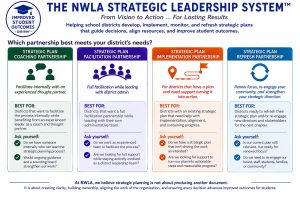
At Northwest Leadership Associates, we believe strategic planning is not about producing another document. It is about creating clarity, building ownership, aligning the work of the district, and ensuring every decision advances improved student outcomes.
Our Strategic Leadership System helps school districts develop, implement, monitor, and refresh strategic plans that guide decision-making, resource allocation, continuous improvement, and student success. Whether developing a new plan, refreshing an existing one, or strengthening implementation, NWLA partners with district leaders to build an approach responsive to their district's needs.
Successful strategic plans are built with a district, not for a district. We help districts engage the voices of their board, leadership, staff, students, families, and community to establish shared direction and build ownership. The result is more than a strategic plan; it is a leadership system consisting of a cycle that turns vision into action and keeps improved student outcomes at the center of the work.
Which partnership best meets your district’s needs?
Dr. Jennifer Bethman - Specialty: Strategic Planning
Dr. Jennifer Bethman retired following a 40-year career in public education, most recently serving as Superintendent of the Rochester School District. As both a superintendent and Assistant Superintendent in the Bethel School District, Jennifer led the development and implementation of district strategic plans. She understands firsthand the opportunity strategic planning provides a superintendent to work with the school board and community to establish shared direction and align the district around priorities for student success. Jennifer brings a thoughtful, research-based, and collaborative approach to the process, engaging school boards, students, staff, families, and communities in developing plans that build ownership, guide district priorities, and focus the work on improving outcomes for students.
Ms. Helene Paroff - Specialty: Strategic Planning
Helene Paroff served as an Assistant Executive Director at the Washington Association of School Administrators (WASA) from 2014 through 2019 with key responsibilities for developing and delivering professional learning throughout the state. She then became Director of WASA’s OSPI-funded, district-supported Inclusionary Practices Project before retiring in 2023. From 1996 to 2014, Helene served in a variety of capacities, including Assistant Superintendent for Student Learning and Support Services at NorthEast Washington Educational Service District 101, based in Spokane, Washington. While working at Erie I BOCES in New York State from 1989 to 1996, Helene was actively engaged with districts throughout the Buffalo area, providing systems-level and instructional support. Throughout her career, she consulted with many school districts and other entities with
Every district is in a different place. Let’s talk about where your district is today and the level of partnership that will best support your next steps.
Contact Dr. Jennifer Bethman at 253-468-0178 or bethmanjennifer@gmail.com
Contact Helene Paroff at 509-593 9512 or heparoff@comcast.net
Third-Party Administrative Fact-Finding
Gaining Clarity Through Independent, Objective Fact-Finding
When sensitive employee or organizational concerns arise, you need reliable information to make sound decisions, address issues appropriately, and restore organizational focus. NWLA’s independent administrative fact-finding process helps you develop a clear understanding of what occurred and determine the appropriate next steps.
You benefit from trained, experienced educational leaders who understand school systems and conduct each review fairly, objectively, and respectfully. NWLA provides a clear, neutral written report grounded in the relevant facts. We do not make legal determinations, recommend discipline, conduct Title IX investigations, or assume the district’s decision-making responsibilities.
Contact Joel Aune or Tom Rockefeller to discuss whether independent fact-finding can help.
Capital Projects and Bond Planning
Turning Facility Needs into Community-Supported Action
By aligning educational priorities, facility needs, financial realities, and community expectations, your district can build a more credible capital plan and a stronger foundation for community support. NWLA helps you clarify priorities, engage stakeholders, and develop a practical path from identified need to informed action.
Drawing on consultants’ firsthand experience successfully leading construction bonds, facility planning, school construction, and other major district initiatives, NWLA provides strategies tailored to your local circumstances. Support may include priority setting, board and leadership facilitation, community engagement, communication, and bond preparation—helping you advance a focused, transparent, and locally responsive capital initiative.
Contact Joel Aune or Tom Rockefeller to discuss your district's capital or bond goals.
Board Governance and Superintendent Relations
Strengthening Governance, Leadership Alignment, and Trust
When the Board and Superintendent share clear expectations, communicate effectively, and remain
focused on their respective roles, your district is better positioned to lead with clarity, consistency, and trust. NWLA helps your leadership team strengthen the working relationships and governance practices that support organizational success.
Through customized workshops and skillfully facilitated conversations, you can clarify roles, strengthen decision-making, address difficult issues constructively, and establish practical agreements for working together. Our consultants bring decades of successful superintendent and executive leadership, board service, mentoring, and governance experience to help you achieve meaningful, lasting progress.
Contact Joel Aune or Tom Rockefeller to discuss your leadership team's goals.
Administrative Coaching
Building Confidence, Capacity, and Leadership Effectiveness
With the right thought partner, you can approach difficult decisions with greater clarity, navigate complex relationships more effectively, and continue growing as a leader. NWLA provides confidential, personalized coaching for superintendents, administrators, and other leaders. You benefit from accomplished educational leaders who understand the demands of leadership firsthand
and have extensive experience mentoring, coaching, and preparing other administrators. Each
engagement is shaped around your circumstances and goals, providing practical perspective, candid
feedback, and strategies that help you strengthen judgment, improve communication, and lead with
greater confidence and effectiveness.
Contact Joel Aune or Tom Rockefeller to discuss personalized coaching support.
Let's Talk
Every district and organization has different needs—and the best starting point is a conversation about what you want to accomplish. Contact Joel Aune or Tom Rockefeller to explore how NWLA’s experience, proven strategies, and personalized support can help you move forward successfully.
Contact Joel Aune or Tom Rockefeller